
Rice Nutrition Facts
By Muhammad Taha, founder of FoodnPedia
Quick answer
100 g of cooked white rice has about 130 calories, 28 g of carbohydrate, 2.7 g of protein, 0.3 g of fat, and 0.4 g of fiber. Cooked brown rice is close on calories at 123 per 100 g, with more fiber (1.6 g) and more magnesium, phosphorus, and potassium. Basmati and jasmine, the two best-known aromatic white rices, sit in the same range as white rice. The single biggest thing that changes rice numbers is water: dry rice has about 365 calories per 100 g, while the same rice cooked has about 130, because cooking adds water weight, not calories.
All figures in this guide are for plain rice cooked in water, with no added oil, butter, or sauce. Brands and cooking methods vary, so check the packet label for the product you buy.
Nutrition per 100 g cooked
The table below uses the U.S. Department of Agriculture’s standard reference records for the two staple types: white long-grain rice, enriched and cooked, and brown long-grain rice, cooked.
| Nutrient per 100 g cooked | White, long-grain | Brown, long-grain |
|---|---|---|
| Calories | 130 kcal | 123 kcal |
| Water | 68.4 g | 70.3 g |
| Carbohydrate | 28.2 g | 25.6 g |
| Fiber | 0.4 g | 1.6 g |
| Sugars | 0.1 g | 0.2 g |
| Protein | 2.7 g | 2.7 g |
| Fat | 0.3 g | 1.0 g |
| Potassium | 35 mg | 86 mg |
| Magnesium | 12 mg | 39 mg |
| Phosphorus | — | 103 mg |
| Calcium | 10 mg | 3 mg |
| Iron | — | 0.6 mg |
A dash means this guide does not give a figure for that cell rather than a zero. White rice and brown rice are close on calories, carbohydrate, and protein. The clearest difference is fiber: brown rice has about four times the fiber of white rice per 100 g (1.6 g against 0.4 g), because brown rice keeps its bran layer. Brown rice also has notably more magnesium, phosphorus, and potassium. White rice in the United States is usually enriched, meaning some B vitamins and iron are added back after milling.
Nutrition per cup cooked
Cups are the serving most people actually use, but cup weights differ by type, which is why per-100 g figures are the reliable basis for comparison.
| Per 1 cup cooked | Weight | Calories | Carbohydrate | Fiber | Protein | Fat |
|---|---|---|---|---|---|---|
| White, long-grain | 158 g | 205 kcal | 44.5 g | 0.6 g | 4.3 g | 0.4 g |
| Brown, long-grain | 202 g | 248 kcal | 51.7 g | 3.2 g | 5.5 g | 2.0 g |
Notice that a cup of brown rice weighs more than a cup of white rice (202 g against 158 g), so the brown cup looks higher in calories even though brown rice is slightly lower per 100 g. If you track portions, weighing cooked rice in grams avoids this confusion entirely.
What % Daily Value means, in plain language
The % Daily Value (%DV) on a nutrition label tells you how much of a day’s reference amount one serving provides, based on a 2,000-calorie day. The U.S. Food and Drug Administration’s reference amounts include 275 g of total carbohydrate, 28 g of dietary fiber, 50 g of protein, 78 g of total fat, 2,300 mg of sodium, and 4,700 mg of potassium. As a rough rule the FDA uses, 5% DV or less is low and 20% DV or more is high.
| Nutrient per 100 g cooked | White rice | %DV | Brown rice | %DV |
|---|---|---|---|---|
| Carbohydrate | 28.2 g | 10% | 25.6 g | 9% |
| Fiber | 0.4 g | 1% | 1.6 g | 6% |
| Protein | 2.7 g | 5% | 2.7 g | 5% |
| Fat | 0.3 g | 0% | 1.0 g | 1% |
| Sodium (cooked without salt) | 1 mg | 0% | — | — |
| Potassium | 35 mg | 1% | 86 mg | 2% |
| Calories (share of a 2,000-calorie day) | 130 kcal | about 7% | 123 kcal | about 6% |
Read this way, a 100 g portion of cooked rice is mainly a carbohydrate food: about a tenth of the day’s carbohydrate reference, with modest protein, very little fat, and — for white rice — almost no fiber. Brown rice’s fiber stands out at 6% DV per 100 g, and 12% DV in a full 202 g cup.
The four types
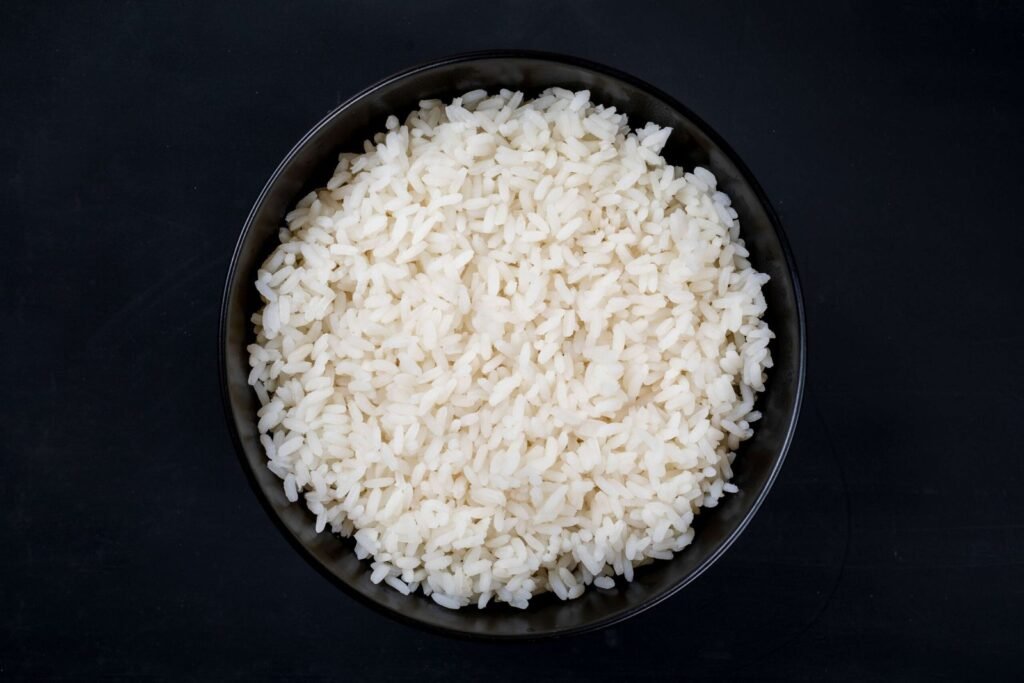
White rice. The everyday staple. Milled to remove the husk, bran, and germ, then usually enriched. Per 100 g cooked: 130 calories, 28.2 g carbohydrate, 2.7 g protein, 0.3 g fat, 0.4 g fiber. Long-grain white rice cooks up fluffy with separate grains.
Brown rice. The whole grain, with the bran layer kept. Per 100 g cooked: 123 calories, 25.6 g carbohydrate, 2.7 g protein, 1.0 g fat, 1.6 g fiber. It takes longer to cook than white rice and has a chewier texture. Its calories are close to white rice; its advantage is fiber and minerals, not a large calorie saving.
Basmati rice. A long-grain aromatic white rice, best known in South Asian cooking, where it cooks dry and separate.
Jasmine rice. A fragrant white rice best known in Thai and Southeast Asian cooking, softer and slightly stickier than basmati. Nutritionally, both are white rices, so they sit close to the white-rice figures above. This guide does not give a separate per-100 g table for them: the USDA’s standard reference records used here are the white and brown long-grain entries, while basmati and jasmine are sold under many brand entries whose values vary. Use the white-rice figures as the closest reference and check the label on the packet you buy.
Dry vs cooked: why the numbers change so much
Dry rice and cooked rice are the same food with different amounts of water in them. Cooking does not remove calories; it adds water, which dilutes the calories per 100 g.
| White long-grain rice | Per 100 g | Calories | Carbohydrate | Protein | Fat |
|---|---|---|---|---|---|
| Dry (raw, unenriched) | 100 g dry | 365 kcal | 80.0 g | 7.1 g | 0.7 g |
| Cooked (enriched) | 100 g cooked | 130 kcal | 28.2 g | 2.7 g | 0.3 g |
Dividing the dry figure by the cooked figure (365 ÷ 130) gives about 2.8. In practical terms, 100 g of dry white rice cooks to roughly 280 g of cooked rice, and the calories stay the same: 365 in the dry 100 g, and about 365 in the cooked 280 g. A full cup of dry white rice (185 g, 675 calories) therefore cooks to roughly 520 g of cooked rice, or about three cups. This is also why the most common rice mistake is mixing up dry and cooked weights: 100 g of dry rice and 100 g of cooked rice are very different amounts of food.
Dry brown long-grain rice is similar, at about 368 calories per 100 g dry (USDA Foundation Foods).
Salt and cooking additions
Plain rice cooked without salt has almost no sodium: about 1 mg per 100 g for white rice. The USDA’s with-salt version of cooked white rice has 382 mg of sodium per 100 g, or about 17% of the daily reference amount. So salted cooking water is the main sodium lever for plain rice — the rice itself is not the source.
Anything added after cooking changes the numbers beyond this guide: oil, butter, ghee, sauces, and fried-rice preparation all add calories and fat that plain cooked rice does not have. This guide gives no figures for those, because they depend entirely on what and how much is added.
Practical takeaways
- Weigh cooked rice in grams when it matters. Cup weights differ by type (158 g for white, 202 g for brown), so cups mislead; the per-100 g figures are the reliable basis.
- If you count carbohydrates, count cooked weight. 100 g of cooked white rice is 28 g of carbohydrate; 100 g of cooked brown rice is 26 g.
- Brown rice’s real difference is fiber and minerals, not calories. At 123 against 130 calories per 100 g, the calorie gap is small; the fiber gap (1.6 g against 0.4 g) is the meaningful one.
- Watch the salt, not the rice. Unsalted cooked rice is nearly sodium-free; salted cooking water takes it to about 382 mg per 100 g.
- Don’t mix up dry and cooked. 100 g dry is about 280 g cooked. Always check whether a number you are using refers to dry or cooked rice.
- Basmati and jasmine are white rices. Treat them like white rice nutritionally and check the packet label for the exact product.
Related reading on FoodnPedia
Frequently asked questions
How many calories are in 100 g of cooked rice?
About 130 for white long-grain rice and about 123 for brown long-grain rice, according to USDA standard reference records.
How many calories are in a cup of cooked rice?
About 205 for a 158 g cup of white long-grain rice, and about 248 for a 202 g cup of brown long-grain rice. The cups weigh different amounts, which is why the brown cup is higher even though brown rice is lower per 100 g.
Is brown rice better than white rice?
On the numbers, brown rice matches white rice on calories and protein, has about four times the fiber, and more magnesium, phosphorus, and potassium. White rice is usually enriched with some B vitamins and iron. Which one suits a meal depends on what the rest of the meal provides; this guide gives the numbers so readers can judge for themselves.
Why is dry rice so much higher in calories than cooked rice?
It isn’t, per grain. Dry white rice has 365 calories per 100 g and cooked white rice has 130 per 100 g because cooked rice is about 68% water. The calories stay the same; the water adds weight.
Does basmati or jasmine rice have fewer calories than regular white rice?
Not in any meaningful way. Both are white rices and sit close to the white-rice figures. Brand entries vary, so check the packet label for the exact product rather than relying on a single generic number.
Does cooking rice in salted water change its nutrition?
It changes sodium a lot and little else. Unsalted cooked white rice has about 1 mg of sodium per 100 g; the USDA’s with-salt version has 382 mg per 100 g.
Sources
- USDA FoodData Central, SR Legacy — Rice, white, long-grain, regular, enriched, cooked (FDC ID 168878). Per-100 g values and 158 g cup weight used throughout.
- USDA FoodData Central, SR Legacy — Rice, brown, long-grain, cooked (FDC ID 169704). Per-100 g values and 202 g cup weight used throughout.
- USDA FoodData Central, SR Legacy — Rice, white, long-grain, regular, raw, unenriched. Dry values: 365 kcal, 79.95 g carbohydrate, 7.13 g protein, 0.66 g fat per 100 g; 675 kcal per 185 g cup.
- USDA FoodData Central, Foundation Foods — Rice, brown, long-grain, unenriched, raw. Dry value: about 368 kcal per 100 g.
- USDA FoodData Central, SR Legacy — Rice, white, long-grain, regular, cooked, enriched, with salt. Sodium value: 382 mg per 100 g.
- U.S. Food and Drug Administration — Daily Value on the Nutrition and Supplement Facts Labels. Reference amounts for a 2,000-calorie day: total carbohydrate 275 g, dietary fiber 28 g, protein 50 g, total fat 78 g, sodium 2,300 mg, potassium 4,700 mg.
General information only, based on the sources listed above. This guide is not medical advice and does not replace advice from a qualified health professional.
Related reading on FoodnPedia: Rice Calories: 1 Cup, 100g, Cooked vs Uncooked & Every Type