
Black Rice Nutrition: Why Forbidden Rice Was Once Only for Emperors
By Muhammad Taha, founder of FoodnPedia
Source checked (not clinical review)
A rice that was once against the law to eat
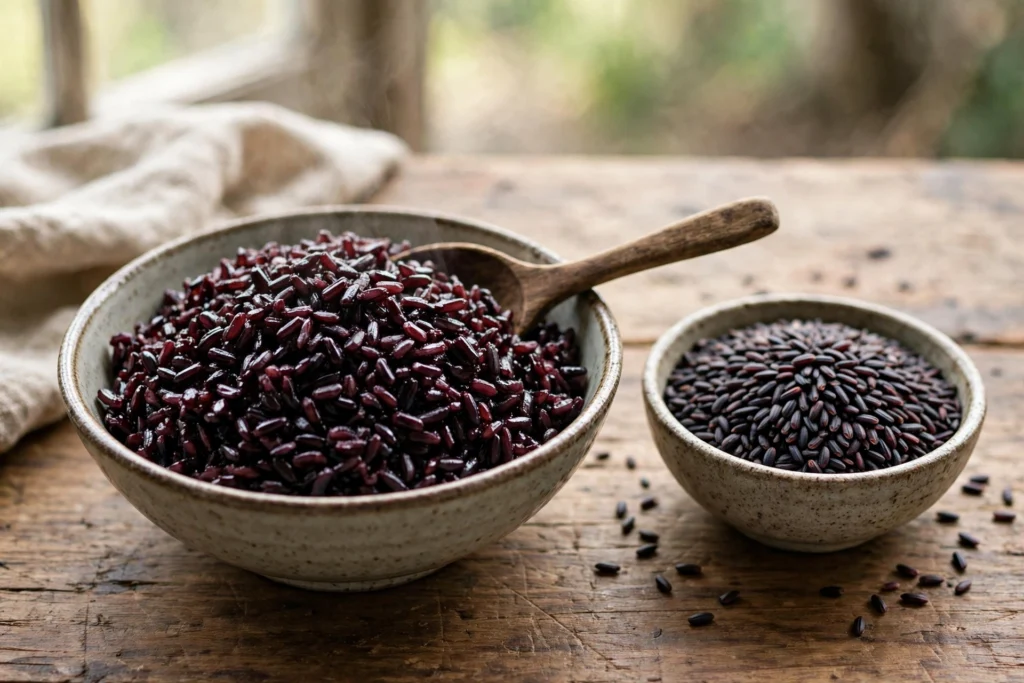
Have you ever seen a bowl of rice so dark it looks almost black? Most of us grew up with white rice on the plate. Brown rice came later, as the “healthy” choice. Black rice is the third rice, and most people have never tried it. It tastes nutty and rich. And it has a story no other rice can match.
Long ago in China, this rice was forbidden to ordinary people. Only emperors and their courts could eat it. That is how it got its name: forbidden rice. The story sounds like a tale from a film. But people have told it for centuries. Today, anyone can buy it. The ban is long gone. The deep colour is still there.
So what makes it so special? Is it really healthier than white or brown rice? And why do websites give such different numbers for it? This guide gives honest answers, with every figure checked.
The emperor’s rice
Black rice is not new. Farmers in Asia have grown it for thousands of years. In old China, it was rare and costly to grow. The grain was dark and the yield was low. Royal families took it for themselves. Common people ate white rice.
The ban did not last forever. Traders carried it across Asia, to India, Thailand, and Indonesia. Each place gave it its own name and dishes. Some call it purple rice. The name changes, but the grain stays the same.
Does the old story prove it is a superfood? No. A royal ban is about rarity, not health. Rarity alone says nothing about nutrition. What matters is what is inside the grain.
What makes it purple?
Cut a grain open and the colour runs deep. The dark coat holds it. That colour comes from plant pigments called anthocyanins. They also make blueberries blue and red cabbage red. In black rice, the main one is cyanidin-3-glucoside, with peonidin-3-glucoside second.
Here is the honest part. The United States Department of Agriculture has no anthocyanin figure for black rice. Studies found very different amounts. One found 79.5 to 473.7 mg per 100 g. Another found 26.5 to 174.7 mg per 100 g. A third found 0 to 470 mg per 100 g. The variety matters most. Where it grew and how fresh it is also matter.
No single number can describe “black rice”. Any site that gives one fixed number is hiding the range. The colour is real. But the amount changes from packet to packet.
Do anthocyanins make it healthier than white rice? They give it something white rice lacks: pigments in the bran. That is real. But they are only one part of the picture.
The nutrition figures: the same basis for all three
This is where most websites go wrong. They mix dry figures with cooked figures, and one brand with another. Then they print one neat number as if it were a fact. Black rice has no generic USDA record. Only branded products exist. That is why the numbers disagree.
The table below uses one basis for all three rices: 100 g of dry, uncooked rice. Dry is the only basis where all three have checked records. Black rice figures are a range across three brands. White and brown figures come from our own rice guide.
| Per 100 g dry | White long-grain | Brown long-grain | Black (3 brands) |
|---|---|---|---|
| Calories | 365 kcal | 367 kcal | 353–372 kcal |
| Carbohydrate | 80.0 g | 76.2 g | 75.6–79.1 g |
| Protein | 7.1 g | 7.5 g | 7.8–11.6 g |
| Fat | 0.7 g | 3.2 g | 2.0–3.5 g |
| Fibre | 1.3 g | 3.6 g | 2.2–9.8 g |
| Iron | 0.8 mg | 1.3 mg | 1.0–2.4 mg |
| Sodium | 5 mg | 5 mg | 0–78 mg |
White: USDA SR Legacy 169756. Brown: USDA SR Legacy 169703. Black: branded records 2106513, 2432339, 2007957. All energy in kilocalories.
The calories are close. Dry black rice has 353 to 372 calories per 100 g. Dry white rice has 365. Dry brown rice has 367. The real differences sit elsewhere.
Protein is the first surprise. Black rice has 7.8 to 11.6 g per 100 g dry. White rice has 7.1 g. Brown rice has 7.5 g. One brand is clearly higher than both. So the brand on the packet matters.
Fibre is the second surprise. Black rice ranges from 2.2 g to 9.8 g per 100 g dry. Brown rice has 3.6 g. White rice has 1.3 g. Some brands beat brown rice by a lot. Others sit below it.
Black rice has 2.0 to 3.5 g of fat per 100 g dry. White rice has 0.7 g, and brown rice has 3.2 g. That is normal for a whole grain. The bran holds the fat, fibre, and minerals.
Iron ranges from 1.0 to 2.4 mg per 100 g dry. Brown rice has 1.3 mg. White rice has 0.8 mg.
Sodium is worth one line. Two brands list zero. One lists 78 mg per 100 g dry. That brand likely adds salt. If you watch salt, read the packet.
What about cooked black rice?
You may have seen a cooked figure online. Some pages say 160 calories per serving. Others say 173. Both may be right for their own serving. Neither is a standard figure. There is no generic USDA record for cooked black rice. So this guide gives no cooked black rice number. That is not a gap in our research. It is the honest state of the records.
For white and brown rice, we do have cooked figures, from our own rice guide. Per 100 g cooked, white rice has 130 calories and brown rice has 123. Per cup cooked, white rice has 205 calories and brown rice has 248 calories.
Why is cooked rice lower per 100 g? Water. Cooking adds water weight, not calories. The same rule holds for black rice. But without a standard cooked record, we will not guess its cooked number here.
Why do other pages disagree?
Now you can see why the numbers clash. One page quotes a brand with 372 calories. Another quotes 353. A third quotes a cooked serving without saying how big it is. All three can be “right” and still disagree. Always ask three questions. Is this dry or cooked? How big is the serving? Which brand is it? If a page cannot answer those, treat its number with care.
How to cook black rice
Black rice takes longer than white rice and needs more water. The bran is tough and needs time to soften. But the method is simple.
Rinse the rice first, in a fine sieve, until the water runs mostly clear. The rinse water will look dark purple at first. That is normal.
Soak the rice next, covered with cold water, for at least 30 minutes. An hour is better. Overnight in the fridge also works. Soaking softens the bran and helps the grains cook evenly. Skip it and the centres may stay hard.
For soaked rice on the stove, use 1.5 cups of water for each cup of rice. Bring it to a boil, then turn the heat low. Cover the pot. Simmer for 30 to 35 minutes. Do not lift the lid to peek.
Rest the rice after cooking. Turn off the heat and leave the lid on for 10 minutes. The grains finish softening in the steam. Then fluff them gently with a fork. One cup dry gives about three cups cooked.
No soak? Use 2 cups of water per cup of rice. Simmer for 40 to 45 minutes, then rest for 10 minutes. The texture may be less even.
A rice cooker also works. Soak for 60 minutes first. Use 1.75 cups of water per cup of rice. Pick the brown rice setting.
One warning: black rice stains. It will tint your pot, spoon, and hands a soft purple. It washes off with soap and water. But keep it away from white cloth you care about.
What does it taste like?
Black rice tastes nutty and earthy. It is chewier than white rice. The grains stay separate when cooked well. It has a mild sweetness that white rice lacks. Some people love it at first bite. Others need a few tries to get used to it.
It works best with strong flavours. Try it with stir-fried vegetables and soy sauce, or in a grain salad with lemon and herbs. Try it with grilled chicken or fish. Black rice pudding with coconut milk is a classic dessert in parts of Asia.
Have you ever cooked a grain just for its colour? Black rice is a good place to start. It turns an everyday meal into something special.
Where to buy it and what it costs
Black rice is easy to find now. Most large supermarkets stock it. Asian grocery shops carry it too, often in bigger bags at a lower price per kilo. You can also buy it online.
It costs more than white rice. That is no surprise. It is grown in smaller amounts. It is sold as a speciality grain. The price changes by brand, bag size, and shop. No fixed price covers all of them. Check the shelf before you buy. A small bag is a good first try.
Read the packet before you buy. Some say “black rice”. Others say “forbidden rice” or “purple rice”. They are the same grain. The ingredients list should say one thing: black rice.
Is black rice worth it?
That depends on what you want from your rice. If you want the lowest calories, black rice will not beat white or brown rice by much. The dry figures are close. If you want more fibre and more protein, some black rice brands do better than both. If you want anthocyanins, black rice is the only rice of the three that has them in any real amount.
It is also worth it for variety. The same white rice every day gets dull. Black rice breaks the routine. It adds colour, texture, and flavour.
But keep it in scale. Black rice is still rice, and still mostly carbohydrate. It will not fix a poor diet on its own. It fits best in a varied diet with vegetables, protein, and other whole grains.
Frequently asked questions
Is black rice healthier than brown rice?
On the checked figures, they are close. Black rice can have more protein and fibre, but it depends on the brand. Brown rice is steadier. Black rice adds anthocyanins. Pick the one you enjoy eating.
How many calories are in a cup of cooked black rice?
There is no verified generic figure for cooked black rice. No USDA record covers it. The dry figures are the honest basis: 353 to 372 calories per 100 g dry. Any cooked number online comes from one brand or one serving size.
Is black rice gluten-free?
Yes. Black rice is naturally gluten-free, like all rice. It has no wheat, barley, or rye in it. But check the packet on a mixed product.
Do I have to soak black rice?
Soaking is not a rule, but it helps a lot. Soak for at least 30 minutes. Without a soak, use more water and cook longer. An overnight soak gives the softest result.
Why does the cooking water turn purple?
The anthocyanins wash off the bran into the water. That is the pigment that makes the grain dark. It is harmless. The cooked rice keeps most of its colour.
Can I use black rice in place of white rice?
Yes, in most dishes. Use the method in this guide, not the white rice method. It needs more water and more time. It works in salads, stir-fries, bowls, and desserts. It will change the colour of the dish.
Sources
- USDA FoodData Central, Branded — Black rice, Nature’s Earthly Choice (FDC ID 2106513). Per 100 g dry: 372 kcal, 11.63 g protein, 79.07 g carbohydrate, 4.7 g fibre, 3.49 g fat, 1.67 mg iron, 0 mg sodium. https://fdc.nal.usda.gov/food-details/2106513/nutrients
- USDA FoodData Central, Branded — Black rice, Village Harvest (FDC ID 2432339). Per 100 g dry: 353 kcal, 7.84 g protein, 76.47 g carbohydrate, 9.8 g fibre, 1.96 g fat, 0.98 mg iron, 78 mg sodium, 157 mg potassium. https://fdc.nal.usda.gov/food-details/2432339/nutrients
- USDA FoodData Central, Branded — Black rice, Nature’s Truth Natural (FDC ID 2007957). Per 100 g dry: 356 kcal, 8.89 g protein, 75.56 g carbohydrate, 2.2 g fibre, 3.33 g fat, 2.4 mg iron, 0 mg sodium. https://fdc.nal.usda.gov/food-details/2007957/nutrients
- USDA FoodData Central, SR Legacy — Rice, white, long-grain, regular, raw, unenriched (FDC ID 169756). Per 100 g dry: 365 kcal, 80.0 g carbohydrate, 7.13 g protein, 0.66 g fat, 1.3 g fibre, 0.8 mg iron, 5 mg sodium. https://fdc.nal.usda.gov/food-details/169756/nutrients
- USDA FoodData Central, SR Legacy — Rice, brown, long-grain, raw (FDC ID 169703). Per 100 g dry: 367 kcal, 76.2 g carbohydrate, 7.54 g protein, 3.2 g fat, 3.6 g fibre, 1.29 mg iron, 5 mg sodium. https://fdc.nal.usda.gov/food-details/169703/nutrients
- FoodnPedia — Rice Nutrition Facts (white and brown rice, cooked figures and cup weights; USDA SR Legacy FDC IDs 168878 and 169704). https://foodnpedia.com/rice-nutrition-facts/
- Chen, Nagao, Itani and Irifune (2012). Anti-oxidative analysis, and identification and quantification of anthocyanin pigments in different coloured rice. Food Chemistry, 135, 2783–2788. Black rice cultivars: 79.5–473.7 mg total anthocyanins per 100 g.
- Phenolic acids, anthocyanins, and antioxidant capacity in rice grains at four stages of development after flowering. Food Chemistry, 2014. Only black rice had detectable anthocyanins: 26.5–174.7 mg per 100 g. Main anthocyanins: cyanidin-3-glucoside and peonidin-3-glucoside. https://www.sciencedirect.com/science/article/abs/pii/S0308814613009709
- Abdel-Aal, Young and Rabalski (2006). Anthocyanin composition in black, blue, pink, purple, and red cereal grains. Journal of Agricultural and Food Chemistry, 54(13), 4696–4704. Black rice: 0–470 mg total anthocyanins per 100 g; cyanidin-3-glucoside most abundant.
- Cooking method (rinse, soak 30 minutes, 1.5 cups water per cup soaked rice, simmer 30–35 minutes, rest 10 minutes; rice cooker 1.75 cups water, brown rice setting). https://www.chefsresource.com/faq/how-to-cook-black-rice/ and https://dozuscook.com/how-to-cook-black-rice/
General information only, based on the sources listed above. This guide is not medical advice and does not replace advice from a qualified health professional.