
Amaranth Nutrition: The Aztec Grain and Leaf We Forgot
By Muhammad Taha, founder of FoodnPedia
Source checked (not clinical review)
A food that fed an empire
Have you ever eaten a food that once fed an empire?
Amaranth did exactly that.
For more than 6,000 years, farmers in Mexico grew it.
It fed the Aztecs, and they held it sacred.
Then it almost vanished from our plates.
Today it is back, and it deserves a second look.
Here is the part most guides skip.
Amaranth is not one food.
It is two.
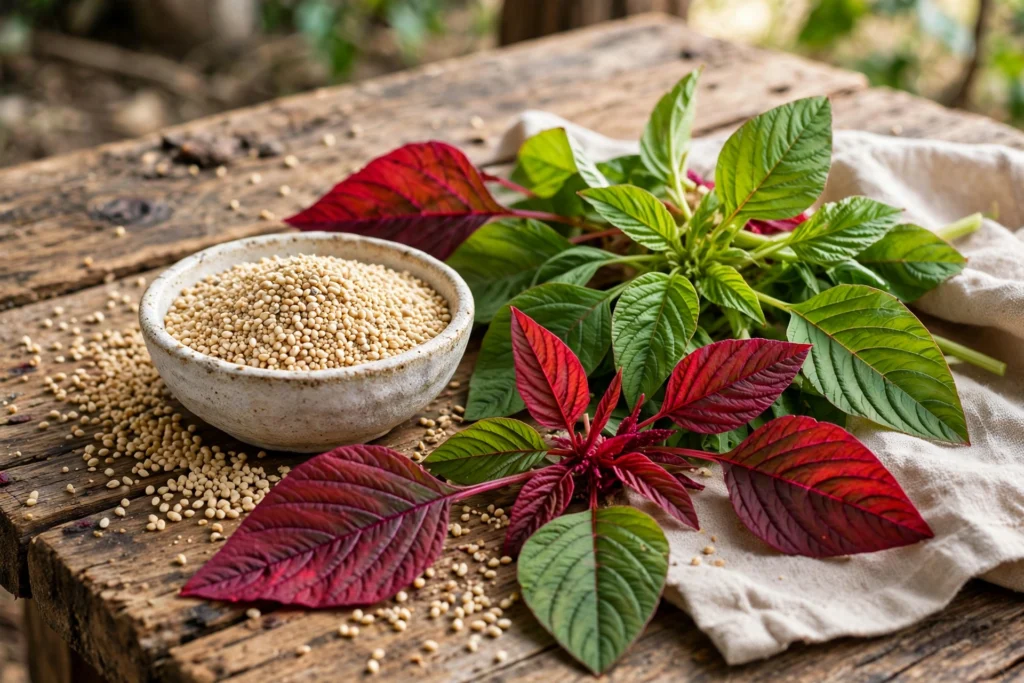
One plant gives a grain and a leafy green.
This guide covers both, with numbers from the USDA.
Read on, and see if it earns a place in your kitchen.
The Aztec story: sacred grain, banned crop
Amaranth grew in the Americas long before Columbus arrived.
Archaeologists found it in Tehuacán, Mexico, where people grew it over 6,000 years ago.
The Aztecs called it huauhtli.
It was one of the five essential plants in their diet.
The Aztecs grew it beside maize and beans.
Provinces paid tribute in amaranth, almost as much as in corn and beans.
It was food, and it was far more than food.
Aztec priests mixed amaranth flour with maguey honey.
They shaped the dough into figures of their gods.
During festivals, people shared the figures and ate them.
The Spanish saw this and called it a threat.
To them, it looked too close to their own communion rite.
So they banned the crop.
A Spanish writer named Sahagún recorded the ban in 1570.
Growing it could bring harsh punishment.
Amaranth did not die out.
It survived in remote villages, kept alive by farmers who knew its worth.
In India, it lived on under the name rajgira.
Today it grows on farms across the world again.
Seed savers kept it alive, and now cooks are finding it again.
That is quite a journey for a tiny seed.
The grain: small seed, complete protein
Amaranth grain is not a true grain at all.
It is a pseudocereal, the seed of a broadleaf plant.
The seeds are tiny.
It has no gluten, so it suits gluten-free cooking.
Its protein stands out.
Most grains lack lysine, an essential amino acid.
Amaranth has plenty of it.
That is why it counts as a complete protein.
One plant food rarely gives you all nine essential amino acids.
Amaranth does.
Uncooked, it packs 371 calories and 13.6 g of protein per 100 g.
It also gives 6.7 g of fibre and 7.6 mg of iron.
That iron figure is high for a grain.
That is 42% of the daily value per 100 g.
Amaranth grain nutrition, per 100 g (USDA FoodData Central)
| Nutrient | Uncooked (FDC 170682) | Cooked (FDC 170683) |
|---|---|---|
| Energy | 371 kcal | 102 kcal |
| Protein | 13.6 g (27%) | 3.8 g (8%) |
| Carbohydrate | 65.3 g (24%) | 18.7 g (7%) |
| Fibre | 6.7 g (24%) | 2.1 g (8%) |
| Fat | 7.0 g (9%) | 1.6 g (2%) |
| Calcium | 159 mg (12%) | 47 mg (4%) |
| Iron | 7.6 mg (42%) | 2.1 mg (12%) |
| Magnesium | 248 mg (59%) | 65 mg (15%) |
| Phosphorus | 557 mg (45%) | 148 mg (12%) |
| Potassium | 508 mg (11%) | 135 mg (3%) |
| Zinc | 2.9 mg (26%) | 0.9 mg (8%) |
| Folate | 82 µg (21%) | 22 µg (6%) |
| Vitamin B6 | 0.59 mg (35%) | 0.11 mg (7%) |
| Vitamin E | 1.19 mg (8%) | 0.19 mg (1%) |
| Lysine | 0.75 g | — |
Percentages are % of the FDA Daily Value. Lysine is shown for dry grain only, as the cooked-grain record does not list it.
Cooked amaranth looks weaker on paper, but do not be fooled.
The grain drinks up water as it cooks.
Water adds weight, not calories, so the numbers per 100 g fall.
One cup of cooked grain still gives 251 calories and 9.3 g of protein.
That is a full bowl, not a sprinkle.
How to cook the grain
Cooking amaranth is simple, but it has one trick.
It turns sticky if you overcook it.
Give it time and water, and it turns creamy.
For porridge, use one cup of grain to three cups of water.
Bring it to a boil, then simmer with the lid on.
Twenty to twenty-five minutes is enough.
Stir near the end for extra creaminess.
Top it like oatmeal, with fruit, nuts, or honey.
Popping is the fun part.
Heat a dry pan until it is hot.
Add one tablespoon of grain at a time.
Shake the pan, and the seeds pop like tiny popcorn.
Each batch takes less than a minute.
Sprinkle the popped grain on yogurt, salads, or soups.
You can also grind raw amaranth into flour.
It works best mixed with wheat or rice flour, since it has no gluten of its own.
The leaves: a green most people throw away
Now the part most people miss.
The leaves are food too.
In many parts of the world, people cook them like spinach.
They cook down soft, much like spinach does.
Raw leaves give 23 calories per 100 g.
That is very light, but the vitamins are not.
They carry 43.3 mg of vitamin C and 215 mg of calcium.
Vitamin C covers 48% of your daily value.
Calcium covers 17%.
The headline figure is vitamin K.
Raw leaves hold 1,140 µg of vitamin K per 100 g.
That is about nine and a half times the daily value.
Remember that number if you take blood thinners.
Cooking changes the leaves a little.
Boiled leaves hold 21 calories and 209 mg of calcium per 100 g.
Vitamin C dips slightly, from 43.3 mg to 41.1 mg.
That is a small loss for a cooked green.
Amaranth leaves nutrition, per 100 g (USDA FoodData Central)
| Nutrient | Raw (FDC 168385) | Cooked, boiled, drained, with salt (FDC 168492) |
|---|---|---|
| Energy | 23 kcal | 21 kcal |
| Protein | 2.5 g (5%) | 2.1 g (4%) |
| Carbohydrate | 4.0 g (1%) | 4.1 g (1%) |
| Fat | 0.3 g (0%) | 0.2 g (0%) |
| Calcium | 215 mg (17%) | 209 mg (16%) |
| Iron | 2.3 mg (13%) | 2.3 mg (13%) |
| Magnesium | 55 mg (13%) | 55 mg (13%) |
| Phosphorus | 50 mg (4%) | 72 mg (6%) |
| Potassium | 611 mg (13%) | 641 mg (14%) |
| Sodium | 20 mg (1%) | 257 mg (11%) |
| Zinc | 0.9 mg (8%) | 0.9 mg (8%) |
| Vitamin C | 43.3 mg (48%) | 41.1 mg (46%) |
| Vitamin A | 146 µg RAE (16%) | 139 µg RAE (15%) |
| Vitamin K | 1,140 µg (950%) | — |
| Folate | 85 µg (21%) | 57 µg (14%) |
| Vitamin B6 | 0.19 mg (11%) | 0.18 mg (10%) |
Percentages are % of the FDA Daily Value. Vitamin K is shown for raw leaves only, as the cooked-leaves record does not list it. The cooked leaves were boiled with salt, which explains the higher sodium. No fibre figure is given for the leaves, as the USDA leaves records do not list fibre.
How to cook the leaves
Cook the leaves well.
Blanch them for one or two minutes, then drain.
Or sauté them with garlic and a little oil.
Use them in soups, stews, or stir-fries.
Do not eat them raw in large amounts.
Cooking matters, and the next section explains why.
The oxalate question: read this first
Here is the honest warning.
Amaranth leaves contain oxalates.
Oxalates are natural compounds found in many greens.
They bind calcium, so your body absorbs less of it.
Eaten in normal amounts, amaranth leaves are fine for most people.
But if you have had kidney stones, take note.
Oxalates can add to calcium-oxalate stones in people who are prone to them.
Cooking helps a lot.
Boiling the leaves and throwing away the water lowers oxalates.
Steaming helps too, but boiling works better.
Two more cautions are worth a line each.
First, the leaves are very high in vitamin K.
If you take a blood thinner such as warfarin, keep your leafy green intake steady.
Tell your doctor before you change it sharply.
Second, variety helps: mix amaranth with other greens through the week.
This is general information, not medical advice.
If you have kidney disease or take regular medicine, ask your doctor first.
Grain vs leaves: which one wins?
So which half of the plant should you eat?
Both, if you can.
They do different jobs.
The grain brings energy and protein.
The leaves bring vitamins and very few calories.
Here is the quick match-up.
| Per 100 g | Cooked grain | Raw leaves |
|---|---|---|
| Energy | 102 kcal | 23 kcal |
| Protein | 3.8 g | 2.5 g |
| Calcium | 47 mg | 215 mg |
| Iron | 2.1 mg | 2.3 mg |
| Magnesium | 65 mg | 55 mg |
| Potassium | 135 mg | 611 mg |
| Folate | 22 µg | 85 µg |
One line sums it up.
Eat the grain for fuel, and the leaves for vitamins.
FAQs
Is amaranth gluten-free?
Yes.
Amaranth has no gluten at all.
It is a seed, not a true grain.
Buy packs marked gluten-free if you have coeliac disease.
Is amaranth a complete protein?
Yes, it gives all nine essential amino acids.
Most grains fall short on lysine.
Amaranth gives 0.75 g of lysine per 100 g of dry grain.
That is its real edge over rice and wheat.
Can I eat amaranth leaves raw?
You can, but cooking is the smarter choice.
Raw leaves hold more oxalates.
Boiling and draining the water lowers them.
Cooked leaves still keep most of their vitamins.
Is amaranth good for weight loss?
No single food causes weight loss.
Cooked amaranth gives 3.8 g of protein and 2.1 g of fibre for 102 calories per 100 g.
That is a filling plate for the calories.
The leaves are lighter still, at 23 calories per 100 g.
Where can I buy amaranth?
Health food shops stock it, often in the grain aisle.
South Asian shops sell it as rajgira.
Ask at a farmers’ market if you cannot find the leaves.
Start with the grain if the leaves are hard to find.
Five centuries after the ban, it is back on our plates.
Give it a try, and see what you think.
This article is general nutrition information, not medical advice.
Figures come from the USDA FoodData Central records listed below.
If you have a health condition, speak to your doctor or a dietitian.
Sources
- USDA FoodData Central — Amaranth grain, cooked (FDC ID 170683): https://fdc.nal.usda.gov/food-details/170683/nutrients
- USDA FoodData Central — Amaranth grain, uncooked (FDC ID 170682): https://fdc.nal.usda.gov/food-details/170682/nutrients
- USDA FoodData Central — Amaranth leaves, raw (FDC ID 168385): https://fdc.nal.usda.gov/food-details/168385/nutrients
- USDA FoodData Central — Amaranth leaves, cooked, boiled, drained, with salt (FDC ID 168492): https://fdc.nal.usda.gov/food-details/168492/nutrients
- Purdue University, New Crops — Grain amaranths (history, cultivation, the Spanish ban): https://hort.purdue.edu/newcrop/1492/amaranths.html
- ThoughtCo — Origins and Use of Amaranth in Prehistoric America: https://www.thoughtco.com/amaranth-origin-169487
- Berkeley Food Institute — The Promise of Amaranth: https://food.berkeley.edu/from-the-field/the-promise-of-amaranth/
- Naturally Ella — Amaranth Recipes, Storage, and Cooking Tips (porridge ratio, popping): https://naturallyella.com/pantry/grains/amaranth/
- Utah State University Extension — Cooking with Amaranth (porridge, popping): https://extension.usu.edu/fscreate/ou-files/handout_amaranth.pdf
- Urban Farm — Amaranth: A Grain for All Ages (tribute, history): https://www.urbanfarm.org/2013/09/13/amaranth-a-grain-for-all-ages/
- Amaranth nutritional properties, lysine and complete protein (book chapter): https://pdfs.semanticscholar.org/010d/e829e0a3f346a6af107db3feccf6ca873f00.pdf
- Epicurean Earth — Amaranth: Ancient Grain Guide & Cooking Uses: https://epicureanearth.com/all-about-amaranth/
- Green amaranth guide: ID, uses, safety (oxalates, cooking, vitamin K): https://therike.com/blogs/herbal-botanical-guides/discover-the-resilience-of-carelessweed-a-guide-to-thriving-green-amaranth
- Amaranth: The Overlooked Plant with Surprising Wellness Benefits (oxalate caution): https://health.pricable.com/2026/09/09/amaranth-overlooked-plant-wellness-benefits/