
Teff Nutrition: Ethiopia’s Tiny Ancient Grain With More Iron Than Most Grains
By Muhammad Taha, founder of FoodnPedia
Source checked (not clinical review)
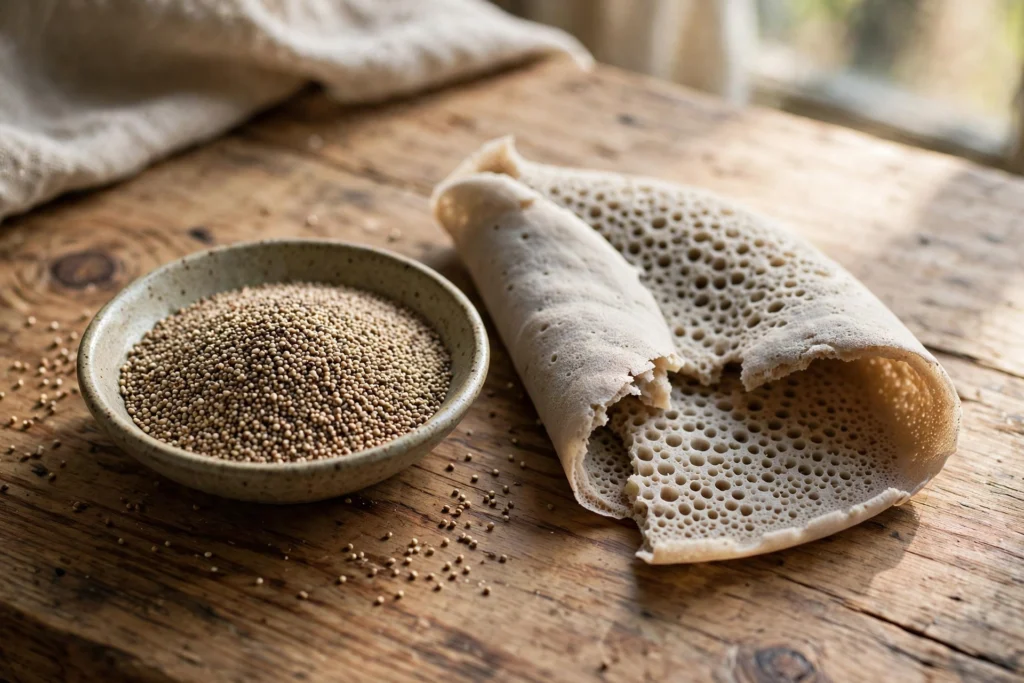
Have you ever held a grain so small it looks like sand? Teff is that grain. It is the smallest grain in the world. One wheat kernel weighs about the same as 150 teff grains. Yet this tiny seed has fed Ethiopia for thousands of years. Have you ever tried it? Most people outside Ethiopia have not. That is a shame, because teff is worth knowing. It is gluten-free, rich in minerals, and full of fibre. This guide gives you the real numbers. It also tells you the honest truth about teff and iron. Some of the old iron figures were too high. We will show you why, and what the true figures are.
A grain from the Ethiopian highlands
Teff comes from the highlands of Ethiopia and Eritrea. Farmers there domesticated it between 4000 and 1000 BC. That means people have grown it for 3,000 to 6,000 years. Its name comes from the Amharic word teffa. Teffa means lost. The name fits a seed this small. It is easy to lose a grain you can barely see. Teff seed is about one millimetre across. It is hard to believe so much food fits in so little seed.
Teff is still the main food crop of Ethiopia today. It feeds more than 50 million people there. Six million farmers grow it. It grows across the Ethiopian highlands. Teff comes in white, brown, and red types. Brown teff is the traditional choice for injera.
Most of it becomes injera. Injera is the soft, spongy flatbread of Ethiopia. It is both the plate and the bread at a meal. Food is scooped up with torn pieces of injera. Have you ever eaten a meal where the plate was bread? That is how Ethiopians have eaten for centuries.
What is in teff?
So what is actually in teff? The numbers below come from USDA FoodData Central. They are the official records for teff, cooked and uncooked. All figures are per 100 grams. Daily values use the FDA daily values for adults.
| Nutrient | Teff, uncooked (100 g) | Teff, cooked (100 g) | Teff flour, Bob’s Red Mill (100 g) |
|---|---|---|---|
| Energy | 367 kcal | 101 kcal | 371 kcal |
| Protein | 13.3 g (27% DV) | 3.87 g (8% DV) | 11.43 g (23% DV) |
| Carbohydrate | 73.13 g | 19.86 g | 77.14 g |
| Fibre | 8.0 g (29% DV) | 2.8 g (10% DV) | 5.7 g (20% DV) |
| Fat | 2.38 g | 0.65 g | 2.86 g |
| Iron | 7.63 mg (42% DV) | 2.05 mg (11% DV) | 5.71 mg (32% DV) |
| Calcium | 180 mg (14% DV) | 49 mg (4% DV) | 180 mg (14% DV) |
| Magnesium | 184 mg (44% DV) | 50 mg (12% DV) | Not listed |
| Zinc | 3.63 mg (33% DV) | 1.11 mg (10% DV) | Not listed |
| Phosphorus | 429 mg (34% DV) | 120 mg (10% DV) | Not listed |
| Potassium | 427 mg (9% DV) | 107 mg (2% DV) | 486 mg (10% DV) |
| Sodium | 12 mg | 8 mg | 0 mg |
| Thiamin (B1) | 0.39 mg (33% DV) | 0.183 mg (15% DV) | Not listed |
| Riboflavin (B2) | 0.27 mg (21% DV) | 0.033 mg (3% DV) | Not listed |
| Niacin (B3) | 3.363 mg (21% DV) | 0.909 mg (6% DV) | Not listed |
| Vitamin B6 | 0.482 mg (28% DV) | 0.097 mg (6% DV) | Not listed |
| Folate | Not listed | 18 µg (5% DV) | Not listed |
Sources: USDA FoodData Central, FDC IDs 169747, 168918, and 2601110. A dash means the record does not list that nutrient.
Cooked teff looks weaker than uncooked teff. That is normal. Cooked teff has soaked up water. Water adds weight but no nutrients. A cup of cooked teff weighs about 252 grams. That cup gives you about 255 calories. It gives you about 5.2 milligrams of iron. That is close to 29 percent of the daily value. It also gives you about 9.8 grams of protein.
Teff flour sits close to uncooked teff. The flour record is from one brand, Bob’s Red Mill. The Bob’s Red Mill flour has 5.71 milligrams of iron per 100 grams. That is 32 percent of the daily value. But that is one brand’s record. Your bag may read a little different. The label on your bag is the final word.
Teff has no gluten. That makes it safe for people who must avoid gluten. It is a whole grain. The tiny seed is too small to split. So you eat the bran, germ, and endosperm together. That is why its fibre stays high.
The iron story, told honestly
Now the iron story. Teff is famous for iron. Some old books call it the best grain source of iron. The truth is more mixed. Some of the old iron numbers were wrong. They were too high. The reason is simple. Teff is threshed on bare ground in Ethiopia. Cattle walk over the grain to free it from the husk. Iron-rich soil mixes in with the tiny seeds. The lab then measures the soil iron as grain iron.
In 1981, two researchers tested this. They washed teff with dilute acid. The iron fell from 39.7 to 3.5 milligrams per 100 grams. That is a huge drop. Later work found the same pattern. A 2013 study compared two ways of threshing the same teff. Grain threshed the old way had 30 to 38 percent more iron. The extra iron came from soil. The clean grain still had 16 milligrams of iron per 100 grams of dry matter. That is still more than wheat, barley, sorghum, and maize.
A 2015 study looked at African cereal foods. It found that processing can raise iron three to ten times. The extra iron came from soil and from tools. It also found that this iron stays mostly in a form the body cannot use. So the high numbers did not mean high iron in the body.
What does this mean for you? Teff is still a good iron source. It is just not the miracle the old numbers claimed. Uncooked teff has 7.63 milligrams of iron per 100 grams. That is 42 percent of the daily value. Cooked teff has 2.05 milligrams per 100 grams. That is 11 percent of the daily value. Those are the honest figures. Use them, not the old ones.
Fermentation and injera: why the old way helps
Injera does more than taste good. Its long fermentation helps your body use the minerals. Teff flour is mixed with water and left to ferment. The wait is two to three days. Wild yeasts and bacteria do the work. The batter turns sour, like sourdough. It is then cooked on a flat clay griddle called a mitad. The result is soft, spongy, and full of holes.
Fermentation breaks down phytic acid. Phytic acid is a compound in grains that traps minerals. It holds iron, zinc, and calcium so the body cannot take them. When fermentation breaks it down, the minerals are set free. One study of Ethiopian teff found that fermentation cut phytic acid by about a third. Another study found that fermentation moved iron into a form the body can use. It also cut the tannins and polyphenols that block iron.
This is why injera is more than a flatbread. It is a smart way to eat teff. The same idea works for other grains too. Fermentation is one of the oldest tricks in cooking.
But there is a catch. Iron in food is not the same as iron in your body. Foods rich in tannins, like tea, can also block iron at a meal. Calcium can block it too. So a cup of tea with injera may cut the iron you absorb. That does not make teff bad. It means the whole meal matters, not just one food.
How to cook teff beyond injera
You do not need injera to enjoy teff. The grain cooks into a soft porridge. Use one part teff to three parts water. Bring it to a boil, then turn the heat low. Simmer for 15 to 20 minutes. Stir often so it does not stick. Add more water if you want it creamier. Toast the dry grains first for a nutty taste. Two or three minutes in a dry pot is enough.
Teff porridge works for breakfast. Add fruit, honey, or nuts on top. It also works as a side dish. Cook it in broth instead of water. Add garlic and a pinch of salt.
Teff flour works in baking. Use it in pancakes, muffins, and flatbreads. It adds a mild, nutty taste. It also helps food hold together. Try half teff flour and half wheat flour first. That mix is easier to work with. Full teff bread can be dense.
Where do you buy teff? Health food shops and online stores sell it. Ethiopian and Eritrean grocers often stock it too. Look for whole teff grain and teff flour. Store it in a sealed jar in a cool, dry place. It keeps for months.
Have you ever swapped your morning oats for a new grain? Teff porridge is a good place to start. It is cheap, quick, and full of minerals. Give it one week and see how you feel.
Frequently asked questions
Is teff gluten-free?
Yes. Teff has no gluten. People who must avoid gluten can eat it. Check the bag for a gluten-free label. That label means the mill kept it free of wheat.
How much iron is in teff, really?
Uncooked teff has 7.63 milligrams of iron per 100 grams. Cooked teff has 2.05 milligrams per 100 grams. A cup of cooked teff gives about 5.2 milligrams. Old figures were higher because soil iron mixed in during threshing.
Is teff good for weight loss?
Cooked teff has about 101 calories per 100 grams. Its fibre helps you feel full. But no single food causes weight loss. Your whole diet decides that.
Can I eat teff every day?
Yes, most people can. It is a whole grain like rice or oats. Mix it with other grains and foods. Variety is better than one grain alone.
What does teff taste like?
Teff tastes mild, with a light nutty note. Toasting the dry grains first brings the nutty taste out more.
This article is general information, not medical advice. If you have a health condition, speak to your doctor. If you take iron tablets, ask your doctor first.
Sources
- USDA FoodData Central — Teff, uncooked, FDC ID 169747 (SR Legacy). Verified via the FDC API, Nov 5, 2026. https://fdc.nal.usda.gov/
- USDA FoodData Central — Teff, cooked, FDC ID 168918 (SR Legacy). Verified via the FDC API, Nov 5, 2026. https://fdc.nal.usda.gov/
- USDA FoodData Central — TEFF FLOUR, Bob’s Red Mill, FDC ID 2601110 (Branded). Verified via the FDC API, Nov 5, 2026. https://fdc.nal.usda.gov/
- Baye, K. et al. (2014). Teff: nutrient composition and health benefits. IFPRI Working Paper 67. https://www.researchgate.net/publication/266316373_Teff_Nutrient_Composition_and_Health_Benefits
- Mouquet-Rivier, C., Baye, K., Icard-Verniere, C., & Guyot, J.-P. (2015). Iron Contamination in Cereal-based Products in Africa Can Challenge the Accurate Estimation of Iron Intakes. European Journal of Nutrition and Food Safety, 5(5), 469-470. https://hal.science/hal-05483339v1
- Baye, K. (2015). Improving iron nutrition from tef (Eragrostis tef) based diets. Doctoral thesis, ETH Zurich, Diss. ETH No. 22091. https://www.research-collection.ethz.ch/server/api/core/bitstreams/d24edc40-bbc0-467d-a462-556b0dac9d9d/content
- Determination of Iron Fractions of Laboratory and Field Threshed Teff Flour, Fermented Dough and Injera: Implications to Iron Bioavailability. Addis Ababa University thesis. https://etd.aau.edu.et/signposting/describedby/840e805d-1bf8-40e7-babd-61eb6662f456
- Whole Grains Council. Teff: Ethiopia’s Tiny Grain with Enormous Nutrition. https://www.ancientgrains.org/teff/
- Gebrehiwot, N. T., & Ndinda, C. (2024). The role of Teff crop in Ethiopian life: consumption and contribution to rural livelihoods. CABI Agriculture and Bioscience, 5, 94. https://ir.unisa.ac.za/bitstream/handle/10500/31900/43170_2024_Article_297.pdf?sequence=1&isAllowed=y
- Wikipedia. Teff. https://en.wikipedia.org/wiki/Teff
- Heal With Food. Breakfast Cereal Cooking Times for 20 Porridge Grains. https://www.healwithfood.org/chart/breakfast-cereals-porridge-cooking-times.php
- Feasting at Home. How to Make Teff Porridge. https://www.feastingathome.com/teff-porridge-with-figs-walnuts-and-honey/