
Electrolyte Drinks vs Water: What to Drink for Workouts, Heat and Illness
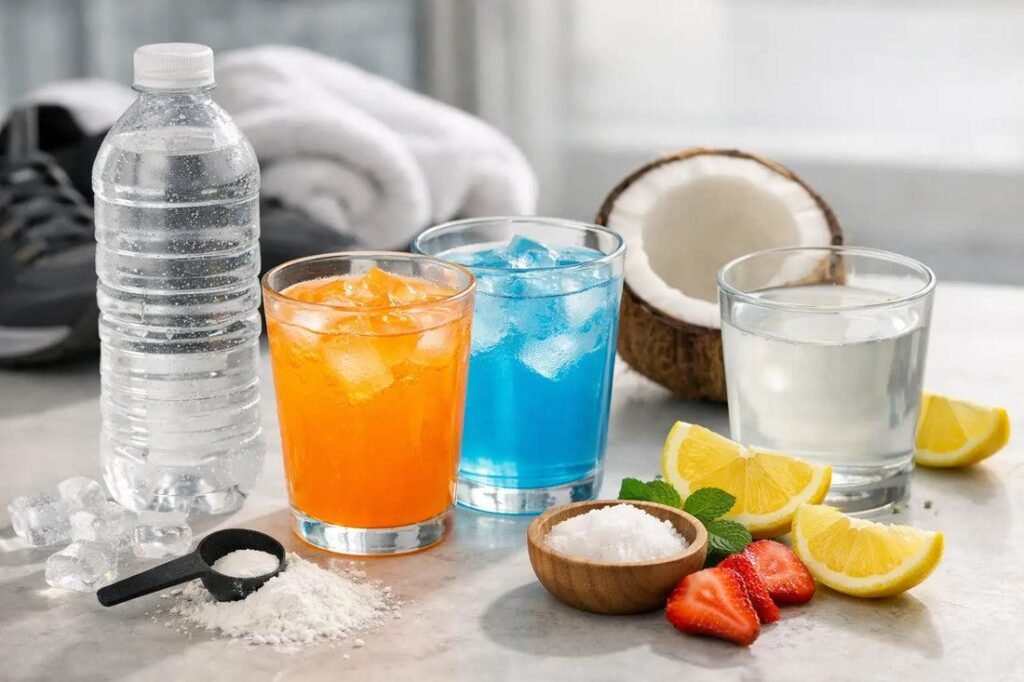
FoodnPedia Nutrition Guide · Hydration, sports nutrition and food science
Do you really need an electrolyte drink after a workout, on a hot day, or when you feel thirsty? Or is ordinary water enough?
With hydration powders, sports drinks and coconut water appearing everywhere, it is easy to assume that adding electrolytes always makes water better. For most healthy people doing everyday activities, plain water plus a normal diet is usually sufficient. But if you sweat heavily for a long time—or lose fluid through vomiting or diarrhea—the answer can change.
This practical guide compares electrolyte drinks vs water, explains when sports drinks are worth considering, shows how coconut water differs, and clarifies why oral rehydration solution (ORS) is not the same as a sports drink. You will also learn exactly what to check on a nutrition label.
1. What Are Electrolytes, and What Do They Do?
Electrolytes are minerals that carry an electrical charge when dissolved in body fluids. They help regulate fluid balance, nerve signaling and normal muscle function, including heart-muscle activity. The major electrolytes include sodium, potassium, chloride, magnesium and calcium.
Sodium: especially relevant to sweat loss
Sodium helps control the balance of fluid outside cells and supports nerve and muscle function. Sweat contains sodium, although the amount varies considerably between people and conditions. That is why sodium—not just potassium—is an important consideration in prolonged, heavy sweating.
Potassium: an essential mineral you can get from food
Potassium helps support normal fluid balance, muscle contraction and nerve signaling. Potatoes, beans, fruits, vegetables and other foods supply potassium. A higher potassium number on a drink label does not automatically make that drink the best choice for every situation.
Magnesium and calcium: important, but not magic hydration boosters
Magnesium and calcium are important to overall health and normal muscle and nerve function. However, most healthy people do not need to add extra magnesium or calcium to every glass of water in order to stay hydrated.
For general food-based mineral information, explore FoodnPedia’s guides to potassium-rich foods, magnesium-rich foods and sodium sources.
2. Water vs Electrolyte Drinks vs Coconut Water vs ORS
These drinks are not interchangeable. They have different purposes and their mineral and sugar contents can vary significantly by product.
| Drink | What it contains | Often useful for | Watch out for |
|---|---|---|---|
| Plain water | Fluid; mineral content depends on source | Everyday hydration and many shorter workouts | Very prolonged heavy sweating may also require sodium replacement |
| Sports drink | Water, electrolytes (often sodium), sometimes carbohydrate | Long or intense exercise and extended heavy sweating | Sugar, sodium and serving sizes vary |
| Electrolyte powder or tablet | Varied sodium, potassium and other minerals; sometimes sugar or sweeteners | Situation-dependent electrolyte replacement | One packet can differ greatly from another; mixing instructions matter |
| Coconut water | Water, natural sugars and potassium; sodium varies | Enjoyable everyday beverage and some fluid replacement | Not necessarily enough sodium for very heavy sweat loss; potassium may be restricted for some people |
| Oral rehydration solution (ORS) | A specific glucose-and-electrolyte formulation | Replacing fluid and salts lost with diarrhea or vomiting, when indicated | Must be prepared exactly as directed; not an ordinary fitness drink |
Important: A drink marketed as “electrolyte water” can contain far less sodium than a sports drink or ORS. Always inspect the actual label instead of relying on the product name.
3. When Is Plain Water Enough?
For most healthy adults on a typical day, drinking water with meals and when thirsty is a sensible starting point. The foods you eat generally supply sodium, potassium and other electrolytes.
Short or moderate workouts
Plain water is generally sufficient for many moderate-intensity exercise sessions lasting less than about an hour, particularly in comfortable weather when sweating is not excessive. You can replace electrolytes through normal meals afterward.
Office work, errands and ordinary daily life
If you are going to work, studying, running errands or walking for a short time, there is usually no reason to add a paid hydration powder to every bottle of water.
Everyday hydration habits
- Keep drinking water available throughout the day.
- Have fluids with meals and when thirsty.
- Drink more when conditions or activity make you sweat more.
- Do not force very large amounts of water in a short period.
Fluid needs depend on body size, weather, exertion, diet, pregnancy, medications and medical conditions. A single rigid “eight glasses for everybody” rule cannot account for those differences.
4. When Might an Electrolyte Drink Actually Help?
The strongest reason to consider an electrolyte-containing drink is substantial fluid and salt loss, not ordinary thirst.
Long endurance sessions
During long runs, cycling events, extended team sports or other strenuous exercise lasting an hour or more, the need for fluid, sodium and sometimes carbohydrate can increase. Duration alone is not an absolute threshold: temperature, sweat rate, intensity and whether you can eat also matter.
Heavy sweating in heat
People doing physical labor outdoors or exercising intensely in hot, humid conditions may lose considerable sodium through sweat. In that setting, electrolyte replacement may be useful alongside rest, cooling and adequate fluid intake.
Repeated workouts or limited opportunities to eat
People performing prolonged or repeated exercise sessions may benefit from a planned hydration and fueling strategy, especially when meals are unavailable during activity.
Not a universal rule
One sweaty workout does not automatically prove that you need an electrolyte packet. Conversely, a short workout in extreme heat with unusually heavy sweating can create meaningful fluid losses. Match the drink to the conditions and your individual needs.
Harvard Health notes that water is generally sufficient for many moderate workouts under an hour, while sports drinks can have a role in longer, more demanding exercise.
5. ORS vs Sports Drinks: Why the Difference Matters During Diarrhea
Oral rehydration solution (ORS) is a medical rehydration formulation. It is designed to replace water and electrolytes lost through diarrhea and some other illnesses.
Unlike an ordinary sports drink, ORS contains a carefully balanced amount of sodium and glucose that helps the intestine absorb fluid. The WHO-recommended reduced-osmolarity formulation contains 75 mmol/L of sodium and 75 mmol/L of glucose, with a total osmolarity of 245 mOsm/L.
That composition is not an invitation to improvise a recipe at home. Use a commercially prepared, properly formulated ORS product and mix it with the exact amount of safe water specified on the packet.
Why not just drink a sports drink?
Sports drinks are formulated for exercise and vary widely in sodium and sugar. The CDC advises that sports drinks do not adequately replace losses for treating diarrheal illness, particularly when diarrhea is substantial. ORS is the more appropriate option when medical rehydration is needed.
When to seek medical care
Seek urgent medical assessment for severe weakness, confusion, fainting, very little urination, inability to keep fluids down, signs of severe dehydration, or bloody diarrhea. Infants, young children, older adults and people with significant medical conditions can deteriorate more quickly. Severe dehydration may require intravenous treatment.
Do not substitute an everyday electrolyte drink for ORS when a clinician or public-health guideline recommends ORS.
6. Is Coconut Water Better Than an Electrolyte Drink?
Coconut water is a popular natural beverage that contains potassium and some other minerals. It can contribute to fluid intake, and many people enjoy it as part of a balanced diet.
However, “natural” does not automatically mean it is better for heavy-sweat rehydration. Sweat losses are particularly relevant to sodium, while coconut water is often promoted mainly for its potassium. The exact composition of coconut water varies by variety, processing and brand.
For everyday use, choose based on taste, cost, portion size, added sugar and your overall dietary needs. For very prolonged heavy sweating, check whether the beverage supplies enough sodium for the circumstances.
Coconut water is also not equivalent to ORS for treating significant dehydration caused by diarrhea.
7. How to Choose an Electrolyte Drink: Read These Five Label Details
Instead of buying the product with the most dramatic claims, use this checklist.
1. Sodium per serving
Sodium content is particularly relevant to replacing sweat losses. A drink with “electrolytes” on the front may provide only a modest amount. Whether a high-sodium product is appropriate depends on your exercise and health circumstances.
2. Actual serving size and mixed volume
Check whether the figures apply to one small bottle, a large bottle or a packet diluted in water. For example, a drink containing 300 mg of sodium in 500 mL provides 600 mg per liter. This calculation makes different packages easier to compare—it does not establish a recommended personal dose.
3. Added sugar and carbohydrate
Carbohydrate can serve a fueling purpose during some prolonged endurance activities. For ordinary hydration, added sugar is usually unnecessary. “Sugar-free” is not automatically better for every athletic situation, and “contains sugar” is not automatically a problem during high energy-demand exercise.
4. Potassium and other minerals
Look at the numbers rather than the list of ingredients alone. A long list of minerals does not necessarily mean meaningful amounts of each one. People who must limit potassium should pay special attention.
5. Instructions and intended use
Hydration tablets, sports drinks and ORS have different purposes. Follow the manufacturer’s mixing instructions and do not treat a concentrated powder as an interchangeable replacement for any other type.
| Label item | Ask yourself | Why it matters |
|---|---|---|
| Sodium | How many milligrams per prepared serving? | Relevant to sweat-loss replacement and sodium restrictions |
| Volume | How much water is one serving mixed with? | Needed for fair comparisons |
| Sugar | Do I need workout fuel or simply a drink? | Carbohydrate has different roles in different settings |
| Potassium | Does my diet or medical situation require a limit? | High amounts are not suitable for everyone |
| Product type | Sports hydration, general beverage or ORS? | These products are not interchangeable |
8. Can You Get Enough Electrolytes From Food?
For most healthy people eating a varied diet, food provides the bulk of daily electrolyte intake. You do not need a separate beverage to obtain every essential mineral.
- Potassium: potatoes, beans, bananas, leafy greens and some dairy foods.
- Magnesium: pumpkin seeds, nuts, legumes and whole grains.
- Calcium: milk, yogurt, calcium-set tofu and selected fortified foods.
- Sodium: table salt and many packaged or prepared foods, along with naturally occurring sodium in some foods.
Food values can vary with preparation and serving size. On FoodnPedia, start with the food search and compare individual records, or browse the potassium, magnesium and sodium food guides.
FoodnPedia’s data methodology explains why comparisons should use consistent portions and why missing food-data values should not be interpreted as zero.
9. Risks, Side Effects and Common Mistakes
Assuming more electrolytes are always better
Your body regulates mineral balance within narrow ranges. Extra electrolytes are not automatically beneficial and can create problems in some circumstances. Drinking excessive water too quickly can also be dangerous.
Overlooking health conditions and medicines
People with kidney disease, heart failure, certain blood-pressure conditions or medications that affect sodium or potassium may need individualized advice. NIH notes that ACE inhibitors and potassium-sparing diuretics can raise the risk of high potassium in susceptible people.
If you follow a prescribed fluid, sodium or potassium restriction, do not start a high-electrolyte drink routine without discussing it with your healthcare professional.
Using sports drinks for significant diarrhea
A sports drink and an ORS are formulated for different purposes. Use appropriate illness-related rehydration guidance when vomiting or diarrhea causes substantial fluid loss.
Ignoring the rest of the nutrition label
A colorful “hydration” claim can distract from added sugar, the amount of sodium, or a serving size that is much smaller than the whole bottle.
Thinking a drink prevents heat illness
Electrolyte products do not replace shade, cooling, breaks or appropriate medical care. Confusion, collapse or severe symptoms during heat exposure require urgent assessment.
10. A Simple Decision Guide: What Should You Drink?
| Situation | Reasonable starting choice | Why |
|---|---|---|
| Working at a desk | Plain water | Normal meals generally supply electrolytes |
| 30-minute gym session | Plain water | Usually sufficient without substantial sweat loss |
| Long, strenuous exercise in heat | Water plus an individualized sodium/fueling strategy; sports drink may help | Fluid and salt losses can be higher |
| Outdoor work with heavy sweating for hours | Regular fluids, breaks, cooling and potentially electrolyte replacement | Sustained sweat losses matter |
| Want a flavored everyday beverage | Water, or another beverage that fits your dietary needs | Choose for preference, not an unproven hydration advantage |
| Significant diarrhea or vomiting | ORS when indicated; seek care if severe | Specific glucose-electrolyte replacement is different from sports hydration |
11. Frequently Asked Questions
Are electrolyte drinks better than water?
Not for everyone. Plain water is sufficient for much everyday hydration. Electrolyte-containing drinks may be useful during prolonged heavy sweating or other substantial losses, depending on the formulation and individual needs.
Do you need electrolytes every day?
You need electrolytes every day, but most healthy people get them through food and ordinary drinks. That does not mean you need a daily electrolyte supplement.
Do you need electrolytes after a 30-minute workout?
Usually not if the workout was moderate, conditions were comfortable and you are eating normally. Plain water is often enough.
Is coconut water better than water for hydration?
Coconut water supplies water and potassium, but it has not consistently been shown to hydrate people better than plain water for ordinary use. Consider sugar, cost, minerals and your specific circumstances.
Is an electrolyte powder the same as ORS?
No. The mineral and sugar composition of general electrolyte powders varies. ORS has a specific rehydration formulation and intended medical use.
Can electrolyte drinks be high in sugar?
Yes. Some sports drinks contain significant added sugar; others are low-sugar or sugar-free. Check the amount per prepared serving. Carbohydrate may be intentional fuel in some endurance sports.
Which electrolyte is most important after sweating?
Sodium is especially important when replacing substantial sweat losses. Actual requirements vary by sweat rate, activity duration, climate, diet and health status.
Can you drink too many electrolytes?
Yes. Too much sodium or potassium can be inappropriate, especially for people with certain medical conditions or who take particular medicines. Follow medical restrictions where applicable.
Will electrolyte drinks cure muscle cramps?
Not reliably. Muscle cramps have multiple possible contributors, including fatigue and exercise demands. An electrolyte drink is not a guaranteed prevention or treatment.
Are sports drinks good for diarrhea?
They are not the preferred substitute for properly formulated ORS when significant rehydration is needed. The CDC specifically distinguishes sports drinks from ORS in treating diarrheal fluid losses.
12. The Bottom Line
Water is the best default for many everyday situations. Add electrolytes for a specific reason—not because an advertisement says everyone needs a powder.
Sports drinks can help during prolonged strenuous activity and heavy sweating; coconut water can be a pleasant potassium-containing beverage; and ORS has a distinct purpose for illness-related fluid loss. Read the label, match the product to the situation and pay attention to medical restrictions.
For food-based sources of sodium, potassium and magnesium, use the FoodnPedia nutrition database and its nutrient guides.
Sources and Research Notes
- Harvard Health — Do you need extra electrolytes? Everyday hydration and exercise use.
- CDC — Clinician Brief: Food Safety. ORS and rehydration during diarrheal illness.
- CDC — About Norovirus. Dehydration and oral rehydration fluids.
- WHO/UNICEF — Oral Rehydration Salts: Production of the New ORS. Reduced-osmolarity formulation.
- NIH Office of Dietary Supplements — Potassium Fact Sheet. Food sources and cautions for some medicines and conditions.
- University of Florida — Summer Hydration Myths. Plain water and prolonged sweating.
- USDA FoodData Central. Food-composition reference database.
Editorial disclosure: This educational guide was prepared with AI-assisted research and writing and should be reviewed for medical and nutrition accuracy by FoodnPedia before publication. It does not replace individual medical advice. Beverage formulas and nutrition labels change; always check current packaging. Do not add a named health-professional reviewer unless that professional actually reviewed this article.